
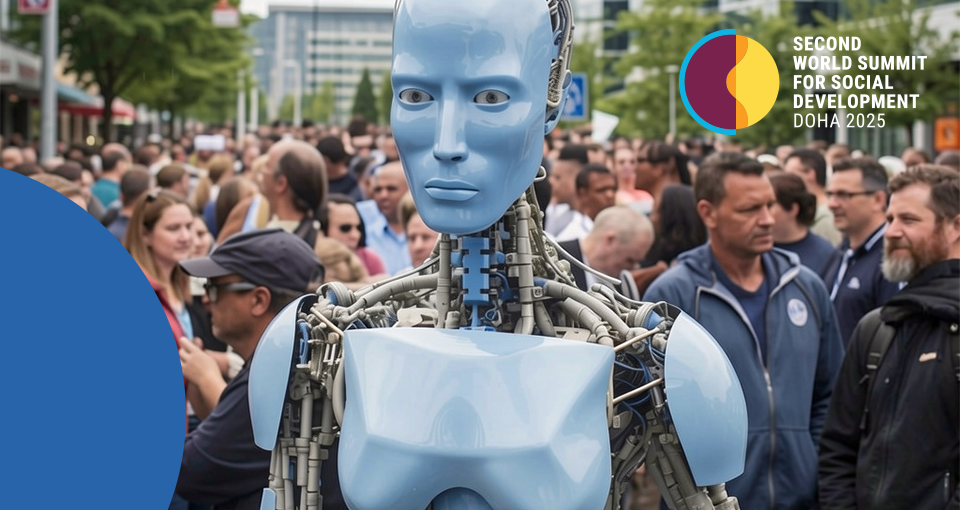
Artificial Intelligence and the Future of the Social Contract

This contribution is published as part of the UNRISD Think Piece Series Beyond Copenhagen: Rethinking Social Development for the 21st Century, which supports UNRISD’s efforts to shape the agenda of the Summit convened in Qatar in November 2025. This series brings together experts from academia, advocacy and policy practice to critically explore the achievements and shortcomings in the implementation of the 1995 Copenhagen Declaration and Programme of Action, current social development challenges, and transformative policies and drivers of positive change. We examine not only the policies and institutional reforms needed for social development and just transitions but also the roles of key actors in advancing social, economic and climate justice. The insights gained from this series have informed the negotiation process of the Political Declaration of the Second World Summit for Social Development, as well as its implementation, monitoring and follow-up.
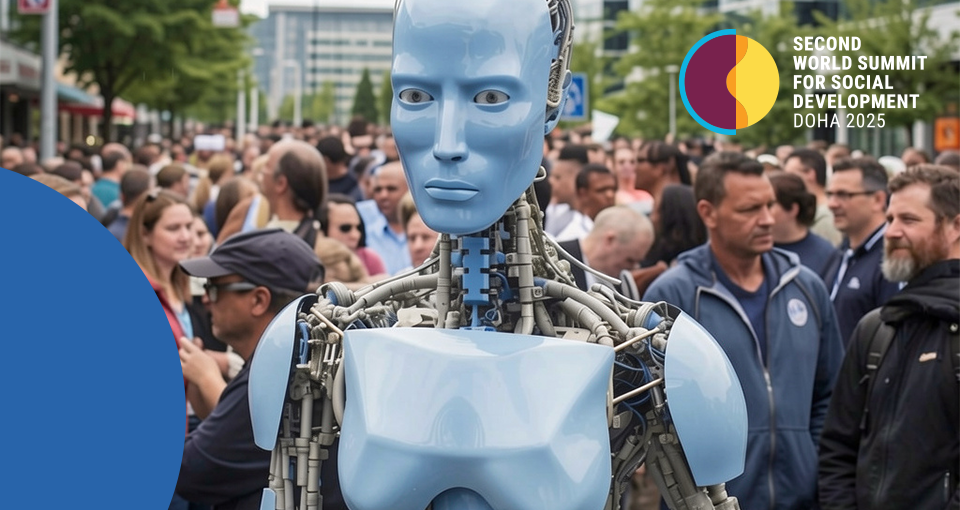
The Political Declaration of the Second World Summit for Social Development recognizes the need to harness the benefits of digital technologies, including AI, while addressing their harms and risks.
Advances in Artificial Intelligence (AI) will have huge benefits, such as increasing productivity and scientific progress. However, these advances will rapidly cause mass job displacement and systemic shocks to societies, accelerating the shrinking of the middle class, and potentially resulting in the collapse of public finances and the social contract (health, education, social security). This process has begun and the window for governments to plan effective responses is rapidly closing.
The growth in AI capability has led to a point where early assumptions that AI would serve mainly as an adjunct to human productivity no longer hold. While more research is needed, it is becoming increasingly evident that the question is no longer whether AI will result in significant job losses, but rather how society can navigate this transformation.
AI will affect nearly 40 percent of jobs worldwide
The International Monetary Fund (IMF 2024) estimates that about 60 percent of jobs in advanced economies are exposed to AI, and that 33 percent fall into a category of “high exposure with low complementarity,” with a high risk that AI substitutes for human tasks rather than complementing them. Table 1 also shows the figures for emerging markets and low-income countries.
Table 1. AI Job Exposure and Displacement Risk by Country Income Groups (% of employment)
| Affected jobs | High Displacement Risk | |
|---|---|---|
| Advanced economies | 60% | 33% |
| Emerging markets | 40% | 24% |
| Low-income countries | 26% | 18% |
Source: IMF 2024
Even if we interpret these figures cautiously, the implications are concerning. New jobs will be created, but many more jobs will be eliminated or displaced (IMF 2026). Job losses affecting roughly one-third of employment in high-income countries, and a quarter in emerging markets, is not a normal business-cycle adjustment: It represents a structural rupture that will reduce the middle class and the welfare state.
A dramatic shrinking of the middle class
The occupations most exposed in this scenario are core middle-class jobs: clerical and administrative roles, customer service, and a growing range of white-collar professional jobs: routine financial and insurance work, legal and paralegal work, translation, journalism, media and marketing content, economic/business analysis, and software and data work, among many others.
Likely labour market outcomes are familiar from past restructuring episodes, but at an unprecedented scale: unemployment for many, wage compression and forced occupational downgrading. Bargaining power erodes as employers can credibly threaten worker substitution by AI. The IMF points to who is hit hardest: women, who are overrepresented in clerical and administrative employment, youth (entry-level jobs), and older workers, who tend to have lower mobility and face more barriers in retraining and hiring.
Income inequality increases due to a distributional shift in favour of capital income and monopoly rents, weakening the labour share.
The dwindling middle class leads to a demand shock
A shrinking middle class is a macroeconomic problem: middle-income households are the consumption engine of economies. If their incomes fall, effective demand contracts.
Lower demand feeds back into the private sector: firms sell less, investment expectations deteriorate, and business closures rise—especially among small and medium enterprises that depend on mass purchasing power. This is how an economy slips into a low-growth trap: chronic underemployment, low wages, persistently weak demand and lower private investment.
A collapse of public finances and austerity cuts to the welfare state
Most states fund themselves heavily through middle-class incomes: personal income taxes and payroll-based social security contributions. Both depend on wage employment. If a large fraction of the labour market is displaced and wages are pushed down, the fiscal base contracts.
Simultaneously, fiscal pressures rise: unemployment benefits, retraining, income support, and higher demand for social services increase fiscal costs as insecurity spreads. This double movement—lower revenues plus higher needs—creates fiscal pressure. Under stress, governments often reach for austerity cuts and economically damaging responses: higher consumption taxes, higher fees for public services, tighter eligibility, and expenditure rationalization. In addition to the human costs, these austerity responses further depress demand—worsening the very problem that caused the fiscal stress.
The decay of social security
Public pension systems rely on pay-as-you-go financing, where current workers fund retirees. In health, healthy people finance those who are sick. If the pool of contributors shrinks, sustainability collapses.
There are only a few ways out: either systems are degraded (benefits are cut, eligibility is tightened), or systems are financed through higher social security contributions, higher collection (formalizing those in the informal economy) and from the general budget. In practice, governments often opt to reduce social security entitlements, and the outcome tends toward a two-tier model: the system deteriorates so those with higher incomes buy private insurance; everyone else faces thinner public provision and income insecurity. That is not only inequitable; it violates human rights and creates social harm by increasing poverty, weakening health outcomes, and raising political instability.
Public services deteriorate
As public revenues fall, governments tend to cut or “consolidate” public spending. Education, health, and care services are often large budget items and thus become adjustment targets. Yet, these services are not optional. They are human rights and the backbone of the social reproduction system that makes countries and their economies function.
As is the case with social security, the likely endpoint is a society where only basic, low-quality public services survive, and the wealthy few use private systems. That is a recipe for entrenched inequality, erosion of the social contract, and political resentment.
Social discontent and democratic crises
AI’s enormous productivity gains benefit very few, but its impacts will impoverish many. When stable work, public services, and social security deteriorate, insecurity rises and trust in democracy falls. People stop believing that the system rewards effort or offers opportunity. Conflicts over redistribution intensify. Political discourse hardens: scapegoating and punitive welfare policies become easier to sell, and repressive, authoritarian states can replace democracies, as governments may be tempted toward coercive management of discontent rather than redistribution.
This is a policy choice, not a natural disaster
None of this is inevitable. The path societies choose will determine whether AI becomes a tool for shared prosperity or a mechanism for inequality and fiscal collapse. A credible policy response must start from the following premise: if AI significantly displaces labour, then the gains from productivity must be captured and socialized so that demand, public finance, social services, and democracies are preserved. That means:
- Tax AI rents—profits, concentrated market power, and capital income—so public finance remains viable.
- Protect demand during the transition. Guarantee income security through stronger unemployment protection and direct transfers, so productivity gains do not turn into falling consumption, weak investment, and economic stagnation.
- Defend and expand public services and social security. Treat health, education, care, and social security as human rights and as the backbone of the social contract; cutting them accelerates inequality and destabilizes democracy.
- Give labour and civil society a voice in AI governance and deployment.
- Regulate AI use and strengthen democracy: prevent manipulation, disinformation, surveillance, and opaque automated decision-making from hollowing out public debate and civic trust; democratic control over AI must increase, not decline.
Change is outpacing our institutions; policy makers cannot afford to hide their heads in the sand. If large parts of the middle class are pushed into insecurity while wealth and power concentrate, the result will not be “efficiency”—it will be the collapse of the welfare state and the social contract upon which democracies rely. The choice is stark: either we create a framework in which the transformative power of AI benefits all, or we drift into a world of stark inequalities, low demand, and political instability. Nobel laureates Acemoglu and Johnson argue that AI’s labour market effects depend less on the technology itself than on the economic and institutional choices governing its deployment. This is the moment to make those choices and act, while democratic governments still have the capacity to steer the transition.
This article reflects the views of the author(s) and does not necessarily represent those of the United Nations Research Institute for Social Development.
Research in Context
This Think Piece Series is part of the UNRISD project Ensuring an Inclusive, Participatory and Actionable Second World Summit for Social Development.
Republised From: https://www.unrisd.org/en/library/blog-posts/artificial-intelligence-and-the-future-of-the-social-contract